Adams County Dog Registration Information
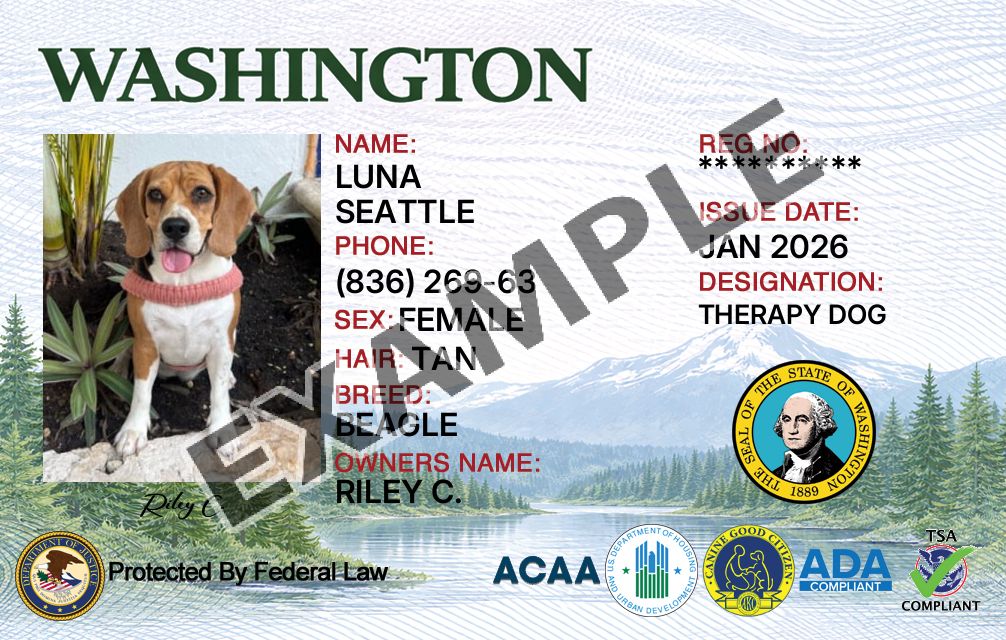
Service Dogs and Emotional Support Animals in Adams, Washington
If you’re asking, “where do I register my dog in Adams County, Washington for my service dog or emotional support dog”, the most important thing to know is that there are usually two separate processes: (1) getting a dog license in Adams County, Washington (often handled by a city or local office), and (2) understanding what makes a dog a service dog under law (training and task performance) or an emotional support animal (typically supported by clinical documentation for housing).
This page explains how licensing typically works locally, what you’ll need (including rabies vaccination proof), and how licensing differs from service dog or emotional support animal status—so you can confidently figure out where to register a dog in Adams County, Washington without paying for third-party services you don’t need.
Where to Register or License Your Dog in Adams County, Washington
Because dog licensing is often handled at the city level (and enforcement may involve local animal control), start by checking whether you live inside a city limit (such as Othello or Ritzville) or in an unincorporated area of Adams County. Below are example official offices within Adams County, Washington, that publish contact details and/or dog licensing information.
Official Offices (Examples)
| Office | Address | Phone | Hours | |
|---|---|---|---|---|
|
City of Othello (Animal Control / Dog Licensing)
City office (within Othello city limits)
|
500 E Main Street
Othello, WA 99344
|
(509) 488-5686 | hmiller@othellowa.gov | Mon–Fri, 8:00 a.m. to 5:00 p.m. PST |
|
City of Ritzville City Hall (Dog License Application / Permits)
City office (within Ritzville city limits)
|
216 E Main Ave
Ritzville, WA 99169
|
(509) 659-1930 | renee.arp@ritzville-wa.us | Not listed |
|
County of Adams Washington (Main Contact)
County government contact (general)
|
210 W Broadway
Ritzville, WA 99169
|
Not listed | Not listed | Not listed |
Tip: If you’re not sure which office applies, start with the city if you live inside city limits; otherwise, contact the county’s main office for direction to the appropriate animal control or licensing resource.
Overview of Dog Licensing in Adams County, Washington
What a dog license is (and why it matters)
A dog license in Adams County, Washington is typically a local registration record connecting your dog to you as the owner. Licensing systems are commonly used to: help return lost dogs faster, support local sheltering/animal control operations, verify rabies vaccination compliance, and provide a way for authorities to contact an owner if a dog is found at large. In many communities, licensing also reduces the time your dog may be held before being transferred to a shelter or rescue.
County vs. city licensing: why the answer is often “it depends”
When people search for animal control dog license Adams County, Washington, they often expect one centralized countywide licensing portal. In reality, licensing frequently happens at the local level: some cities administer their own tags and renewals, while other areas may rely on different local arrangements. That’s why the first step in answering where to register a dog in Adams County, Washington is confirming whether you live in a city jurisdiction (like Othello or Ritzville) or in an unincorporated area.
Rabies vaccination requirements
In most licensing systems, you’ll be asked to show proof of rabies vaccination before a license is issued or renewed. Keep a copy of your rabies certificate and rabies tag number. If your dog is due for a booster, schedule it with a veterinarian first—then complete licensing after you have updated documentation.
How Dog Licensing Works Locally in Adams County, Washington
Step 1: Confirm your jurisdiction (city limits vs. unincorporated area)
Local rules can change depending on your address. If you live inside the City of Othello or the City of Ritzville, the city may require you to purchase and renew a city license tag. If you live outside city limits, you may need to contact county offices to find out what local agency handles licensing and enforcement for your area.
Step 2: Prepare the common documents
While each office sets its own process, most local licensing workflows are similar. Expect to provide: your contact information, your dog’s identifying details (name, breed description, color, age), and rabies vaccination proof. Some locations also set different rates depending on whether your dog is spayed or neutered.
Step 3: Pay the fee and keep the tag on your dog
After your application is accepted, you’ll typically receive a tag (or a record) tied to a specific license year. Many ordinances require the tag to be worn on the dog’s collar. Keeping the tag on your dog can reduce delays if your dog is found and helps animal control identify ownership quickly.
What if my dog is a service dog or emotional support animal?
In most cases, a service dog or emotional support animal is still a dog, which means local licensing and rabies rules can still apply. The difference is that legal access rights and housing rules are determined by disability and housing laws—not by a dog license record. Licensing is usually about identification and public health; service/ESA status is about legal protections and appropriate documentation.
Service Dog Laws in Adams County, Washington
What legally qualifies as a service dog
A service dog is generally a dog trained to perform specific tasks for a person with a disability (for example: guiding someone with low vision, alerting to seizures, interrupting self-harm behaviors, retrieving medication, or helping with mobility). The key is task-trained work that mitigates a disability—not the breed, a vest, an online registry, or a certificate.
No special “service dog license” is usually required
People searching “register my service dog” are often targeted by paid registries. In practice, service dog legitimacy is typically established by: the handler’s disability-related need and the dog’s training and behavior in public. A local dog license (tag) may still be required as part of the standard licensing process in your jurisdiction.
How service dog status interacts with animal control and licensing
Service dogs must still follow public safety rules (leash control where required, non-aggressive behavior, and vaccination requirements). If you need help figuring out which licensing office applies to your address in Adams County, start with your city office (if in city limits) or call the county’s main office to request the correct animal services contact for your area.
Emotional Support Animal Rules in Adams County, Washington
What an emotional support animal is (and is not)
An emotional support animal (ESA) is generally an animal that provides comfort or emotional benefit and may be supported by documentation from a qualified healthcare provider for certain housing-related needs. ESAs are not the same as service dogs because they are not necessarily trained to perform specific tasks related to a disability.
Public access vs. housing protections
ESAs do not automatically have the same public access rights as service dogs (for example, entering areas where pets are prohibited). ESAs most commonly arise in the context of housing requests and accommodation processes. Regardless of ESA status, your local jurisdiction may still require a standard dog license and proof of rabies vaccination.
Do I “register” an ESA with the county?
Typically, you do not “register” an ESA with a county office as a separate legal category. Instead, you license the dog like any other dog for local compliance. If your goal is housing accommodation, the documentation process is generally handled with your housing provider—not through a dog licensing counter.
Frequently Asked Questions
Register A Dog In Other Washington Counties
Select your county below to get started with your dog’s ID card. Requirements and license designs may vary by county, so choose your location to see the correct options and complete your pup’s registration.
- Asotin County Dog Registration
- Benton County Dog Registration
- Chelan County Dog Registration
- Clallam County Dog Registration
- Clark County Dog Registration
- Columbia County Dog Registration
- Cowlitz County Dog Registration
- Douglas County Dog Registration
- Ferry County Dog Registration
- Franklin County Dog Registration
- Garfield County Dog Registration
- Grant County Dog Registration
- Grays Harbor County Dog Registration
- Jefferson County Dog Registration
- King County Dog Registration
- Kitsap County Dog Registration
- Kittitas County Dog Registration
- Klickitat County Dog Registration
- Lewis County Dog Registration
- Lincoln County Dog Registration
- Mason County Dog Registration
- Okanogan County Dog Registration
- Pacific County Dog Registration
- Pend Oreille County Dog Registration
- Pierce County Dog Registration
- San Juan County Dog Registration
- Skagit County Dog Registration
- Skamania County Dog Registration
- Snohomish County Dog Registration
- Spokane County Dog Registration
- Stevens County Dog Registration
- Thurston County Dog Registration
- Wahkiakum County Dog Registration
- Walla Walla County Dog Registration
- Whatcom County Dog Registration
- Whitman County Dog Registration
- Yakima County Dog Registration